 A family from Maryland was traveling southbound on Interstate 95 early Saturday morning and had a horrible traffic accident. In their van were the mother and father and their 10 children. The youngest child (just five weeks old) was killed and several others suffered grievous injuries. Please lift this family up in prayer.
December 18, 2006
Prayer Request
A family from Maryland was traveling southbound on Interstate 95 early Saturday morning and had a horrible traffic accident. In their van were the mother and father and their 10 children. The youngest child (just five weeks old) was killed and several others suffered grievous injuries. Please lift this family up in prayer.

St. Justin Martyr
 This photograph was taken yesterday morning following the Divine Liturgy at St. Justin Martyr.
December 14, 2006
'Tis The Season

My postings will be sporadic over the next few weeks. Like many of you I am caught up in church, work, home and the season.
December 4, 2006
Life In A Bowl
When I first moved to coastal southeast Georgia more than 11 years ago I found the place to be strange and unattractive. Everything was too flat, the roads were too straight and there were no hills. Everything felt too wide open with no proper sense of horizon and very little changing of the seasons, just from summer green to dull winter brown then back to green. And there were way too many insects, with palmetto bugs, love bugs, sand gnats and banana spiders just to name a few. I did, however, find the mild winters and longer winter days particularly attractive and I see now that this area has a stark, subtle beauty all its own (see the photos on the previous entry).

Part of the problem was the contrast and comparison. I spent most of my younger years living on the eastern edge of Virginia’s beautiful Shenandoah Valley (see above photo), a place of ancient mountains worn, but not mellowed by time, still immense, still formidable. Of deep green valleys, rolling hills, a pastoral beauty with a palpable sense of history. It was life in a bowl. I felt protected, hemmed in, nestled in the bosom of creation.
Not to push the conceit too far, but moving from Protestantism to Orthodoxy was the journey in reverse, from barren to bountiful, from less to more. From a tradition essentially barren to a tradition rich in history yet not compromised. The change really began with the move from non-liturgical (Baptist) to liturgical (Lutheran and to a lesser degree Episcopalian) when I realized that the emphasis should be on worship and the Church, not on the pastor and his/her rhetorical skills. For many, many years I sat there wondering if that was all there was to it. I came to church, gave money, was berated for being a backslidden sinner and for not doing enough proselytizing. I went home, said my prayers, read my Bible, felt guilty for never doing enough and constantly worried about Hell. It was a flat, monochromatic world.
In the Orthodox Church (and the Divine Liturgy) I found the sense of reverence, an acknowledgement of our proper position in relation to God. It was also a journey back in time, like coming home to a place I had never been before. A place of beauty, with changing seasons, where the hills and valleys are part of the journey, where there is always something new to discover just around the bend. A world of color and texture, a world of scent and touch, a place where worship is not just an intellectual exercise.
And more importantly for me, just the belief that we are on a journey, that we will stumble and fall but God still loves us. That the true faith has been kept inviolate and it is a message of love, not condemnation.
Part of the problem was the contrast and comparison. I spent most of my younger years living on the eastern edge of Virginia’s beautiful Shenandoah Valley (see above photo), a place of ancient mountains worn, but not mellowed by time, still immense, still formidable. Of deep green valleys, rolling hills, a pastoral beauty with a palpable sense of history. It was life in a bowl. I felt protected, hemmed in, nestled in the bosom of creation.

Not to push the conceit too far, but moving from Protestantism to Orthodoxy was the journey in reverse, from barren to bountiful, from less to more. From a tradition essentially barren to a tradition rich in history yet not compromised. The change really began with the move from non-liturgical (Baptist) to liturgical (Lutheran and to a lesser degree Episcopalian) when I realized that the emphasis should be on worship and the Church, not on the pastor and his/her rhetorical skills. For many, many years I sat there wondering if that was all there was to it. I came to church, gave money, was berated for being a backslidden sinner and for not doing enough proselytizing. I went home, said my prayers, read my Bible, felt guilty for never doing enough and constantly worried about Hell. It was a flat, monochromatic world.
In the Orthodox Church (and the Divine Liturgy) I found the sense of reverence, an acknowledgement of our proper position in relation to God. It was also a journey back in time, like coming home to a place I had never been before. A place of beauty, with changing seasons, where the hills and valleys are part of the journey, where there is always something new to discover just around the bend. A world of color and texture, a world of scent and touch, a place where worship is not just an intellectual exercise.
And more importantly for me, just the belief that we are on a journey, that we will stumble and fall but God still loves us. That the true faith has been kept inviolate and it is a message of love, not condemnation.
November 26, 2006
Day At Okefenokee
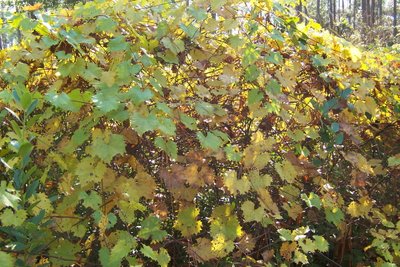
These photographs were taken on the afternoon of November 25, at Okefenokee National Wildlife Refuge. It's an amazing place.










November 22, 2006
Signal 7 and Thanksgiving
It was not a promising beginning to the Thanksgiving holiday. At 7:52 this morning I received a page that said, “Signal 7, 80 year old female.” A Signal 7 is a death. Then at 11:35 I received another that said, “9 month old baby not breathing.” I later learned that the baby was also Signal 7. This evening at 7:24 I received yet another page that said officers were investigating a possible 10-67 (sexual assault). Despite the fact that I live and work in a fairly rural county is south Georgia, sadly, such days are not all that atypical.
Responding to the death of a child has always had a profound impact on me (and evryone else involved). One of the worst was when a mother had innocently put an adult blanket into her baby’s crib to keep her warm. Sometime during the night the little girl became entangled in the blanket and smothered. I was with another officer and he was dealing with the family while I stood at the door to the child’s bedroom to keep everyone out. I could see that the baby had died face down as the fluids had begun to pool in her cheeks and the tip of her nose. The paramedics arrived shortly after we did and went into the bedroom, realized the obvious and almost immediately walked back out. I was not aware at the time that the mother was still harboring hope that her daughter was alive. When the paramedic walked back into the living room she let out a wail/scream that I will never forget, it still raises the hair on my neck. It was like the sound of her soul leaving her body.
My youngest daughter at the time was about six months old, the same age as the baby girl who died. I took it very hard, but I got to walk away, to get up the next day, to hug my daughter and still have my family complete. When blinded by grief as that mother was, there is no hope, no giving of thanks. The same with the families today, mourning the loss of a matriarch, the loss of innocence and the loss of their dearest treasure. Today and tomorrow and for many days to come there will be no thanksgiving, no joy, no holiday spirit.
But eventually the pain will ebb, the tears will slow and the memories will either fade or become a source of comfort. The holidays will be hard but bearable. God has designed us to be able (in most circumstances) to absorb such emotional trauma and somehow heal, to reconcile ourselves with the certainty of our limited time in this life. So while you can, hug your spouse, your children, your siblings, your parents. Give thanks to God for your family and your loved ones.
And be careful if you’re traveling. There will be a lot of hurried, tired people and a lot of police on the roads with you.
Responding to the death of a child has always had a profound impact on me (and evryone else involved). One of the worst was when a mother had innocently put an adult blanket into her baby’s crib to keep her warm. Sometime during the night the little girl became entangled in the blanket and smothered. I was with another officer and he was dealing with the family while I stood at the door to the child’s bedroom to keep everyone out. I could see that the baby had died face down as the fluids had begun to pool in her cheeks and the tip of her nose. The paramedics arrived shortly after we did and went into the bedroom, realized the obvious and almost immediately walked back out. I was not aware at the time that the mother was still harboring hope that her daughter was alive. When the paramedic walked back into the living room she let out a wail/scream that I will never forget, it still raises the hair on my neck. It was like the sound of her soul leaving her body.
My youngest daughter at the time was about six months old, the same age as the baby girl who died. I took it very hard, but I got to walk away, to get up the next day, to hug my daughter and still have my family complete. When blinded by grief as that mother was, there is no hope, no giving of thanks. The same with the families today, mourning the loss of a matriarch, the loss of innocence and the loss of their dearest treasure. Today and tomorrow and for many days to come there will be no thanksgiving, no joy, no holiday spirit.
But eventually the pain will ebb, the tears will slow and the memories will either fade or become a source of comfort. The holidays will be hard but bearable. God has designed us to be able (in most circumstances) to absorb such emotional trauma and somehow heal, to reconcile ourselves with the certainty of our limited time in this life. So while you can, hug your spouse, your children, your siblings, your parents. Give thanks to God for your family and your loved ones.
And be careful if you’re traveling. There will be a lot of hurried, tired people and a lot of police on the roads with you.
November 20, 2006
The Gospel of John, Paul, George and Ringo?
 I had an otherworldly experience at B&N the other day. Beside (literally) two volumes of the Philokalia was The Gospel According to The Simpsons: The Spiritual Life of the World's Most Animated Family. It was the clash of the Titans, ancient Orthodox wisdom up against Homer Simpson. Doh! It was surreal. No wonder our culture is confused and finds it easy to look dismissively at Christianity.
Two shelves down was an even more astonishing tome entitled, The Gospel According to the Beatles. Why are we not looking to the Gospel according to Matthew, Mark, Luke and John instead of John, Paul, George and Ringo? Does Hey Jude count? What’s next, Gospel Girls Gone Wild?
I know the argument can be made that The Simpsons are for the most part harmless fun and I understand that under all the bluster and one-liners Homer (despite himself) is a loving father. And I understand that The Beatles were revolutionary and brought unprecedented depth and virtuosity to popular music. But we have gone too far when we start diluting the Gospel and looking to secular culture for our spiritual guidance.
These examples are just a proverbial drop in the bucket. There is a whole wall stacked high with Christian books, thousands of them (not including the Bibles, that’s another large section), Christian history, Christian apologists, Christian critics, even Christian fiction. There is a lot of good to be said for this. Trying to make people feel better about themselves, to help them cope and to encourage them to explore a spiritual dimension are in and of themselves good things. It’s when the message gets lost in the medium that the trouble starts. I believe that the ELCA congregation with which I used to worship eventually folded the tent (at least partly) because we tried too hard to accommodate everyone. We changed everything including the name and even the liturgy to try to meet people “where they are” instead of letting them bump up against Truth and began to conform to it. Too many people dealing with spiritual issues try to find a creator, a higher power, a life force to suit their tastes. Sometimes we are left with no choice but the path that leads through the narrow gate.
Society is like a bell curve, with some people on each end of the spectrum and many meandering in the middle. I may not know exactly where I am on the graph, but I do know where I am going.
What I eventually found to read I found at our own church bookstore. It was exactly what I was looking for, Of Water and the Spirit: A Liturgical Study of Baptism by Fr. Alexander Schmemann.
November 16, 2006
The Symbol Of Faith
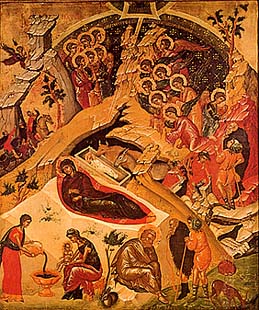 Standing in the darkened church faintly illumined in flickering candlelight, with the aroma of incense hanging in the warm air, together we recited these words...
I believe in one God, the Father Almighty, Maker of Heaven and Earth and of all things visible and invisible. And in the Lord Jesus Christ, the Son of God, the only-begotten, begotten of the Father before all ages. Light of light; true God of true God; begotten, not made; of one essence with the Father, by Whom all things were made; Who for us men and for our salvation came down from Heaven, and was incarnate of the Holy Spirit and the Virgin Mary, and became man. And He was crucified for us under Pontius Pilate, and suffered, and was buried. And the third day He arose again, according to the Scriptures, and ascended into Heaven, and sits at the right hand of the Father; and He shall come again with glory to judge the living and the dead; Whose Kingdom shall have no end. And in the Holy Spirit, the Lord, the Giver of Life, Who proceeds from the Father; Who with the Father and the Son together is worshipped and glorified; Who spoke by the prophets. In one Holy, Catholic, and Apostolic Church. I acknowledge one baptism for the remission of sins. I look for the resurrection of the dead and the life of the world to come. Amen.
Such a simple act brought a tremendous flood of emotion. I felt caught up in the sweep of the past wondering how many times over the better part of the last 17 centuries, in dank caves and in gloriously illuminated naves, the same words were chanted? Not just language, not just print on paper, but ancient words that reflect the deep truths that define us collectively and individually. Sentences pared down to the necessary, nothing extraneous, everything essential.
In darkness and in light, in time of toil and in time of trouble, through feast and famine, through plenty and through depravation, through every possible trial, under every conceivable circumstance, day after day, in tongues foreign and domestic all those who have gone before us kept the flame of faith burning brightly. We are merely the next link in the chain that ties us to the past and offers a hand to the future, neither the first nor the last to hold firm to the faith handed down by the Fathers. I am reminded that we are called to be a light on a hill, a flicker of brilliant grace in a gray world.
Together we stood, tired and hungry, reciting the small Compline with the voice of the reader ringing clear in the near-darkness. Just visible outside the circle the icons glow, Pantocrator, Theotokos, St. John the Forerunner, St. Justin, Gabriel and Raphael seeming to embrace us, reminders that we are in good company as we pursue the path to Godliness.
Lord have mercy, Lord have mercy, Lord have mercy.
November 10, 2006
November Is the Cruelest Month
Begin, and cease, and then again begin,
With tremulous cadence slow, and bring
The eternal note of sadness in.
Matthew Arnold
With tremulous cadence slow, and bring
The eternal note of sadness in.
Matthew Arnold
Dover Beach

Not to belabor the point, but below is an account of what happened 35 years ago this month. Some things you just don't forget.
The shelter squats at the foot of these solemn blue ridges where the forest, long dominant and ungiving, is now slowly dying. The dirty, white, battered shell that serves as a house is one of many that dot the mountains like wood chips on a rumpled blue-brown-green carpet. It is the last building on the left before the road succumbs to the mud and dies at the edge of the woods. Rough planks and irregular support posts serve as a partial bridge over the nearly omnipresent moat of mud that at this time of year is the front yard. A green tar-paper roof and crumbling red brick chimney only slow the rain water and melting snow. The house was thrown together without insulation and the wind whistles through the white clapboard exterior. The only amenities are electricity and cold running water.
Inside are three rooms with old beds. A living room with a round woodstove, a sagging three cushion floral couch and a torn black chair. Another room has the cooking stove, a table, five chairs and a sink. The sixth room is outside to the left of the front opening, about twenty yards down the path.
It is the day for giving thanks in the bitter winter of 1971. The bleak night blanketed several inches of new snow onto the old froth of mud and snow, temporarily camouflaging the chaos with a cold purity. Dirty, low hanging cotton ball clouds threaten to drop more snow as the green-sweet smell of damp wood trying to burn chokes the air, trapped there by the low clouds and no wind.
The morning sputters in to replace the night. The fading moon illuminates two monstrous oaks anchored in the mud. They branch together, tangled in a headstone arch over the house. The air is chilled and quiet except for patches of snow diving from trees and power lines to meet their grounded companions in a muffled whisper of recognition.
The home. In the sleeping room closest to the left of the living room, a man and woman blow faint mushrooms of visible breath into the frigid air. The woman's unsleep is a thin skin of exhaustion over a churning drum of desperate fear. The stick thin man has slept long and deep in the stupor of disease and alcohol. They have long been partners in dying, like two leeches set upon one another, struggling, fighting, sucking out life and soul but unable or unwilling to pull away.
More mushrooms of breath rise into the air. Three boys in two beds in the one room and two girls sharing a bed in the back coldest room. Their short young lives have been long and desperate. The eldest son is proud and defiant. He hates the father for the sins of the past and for the mire of the present. The oldest sister is proud but not defiant. She has to try to mother while still a child. The Middle Child survives in a world of his own making because he cannot bear the pain of existence. His wall of non-reality keeps too much out and too much in. The youngest son is a wildman straining in the skin of a boy. His wildness is his pain brought forth and hurled back to/at its source. The youngest girl, and smallest sibling, is potent sarcasm. Too small to fight physically, she poisons with words. She is the brunt and the receptacle of the family's anger.
The time. Reluctantly the mother sluggishly slides into her cold, stiffened clothes. The trousers and blouse, coat, gloves and slippers slide on with the familiarity of long acquaintance. Once dressed, the mother ghosts steadily and easily through the tomb-dark house. A menthol non-filter cigarette, ignites a furious fit of coughing. Despite the healthy objection, her lungs greedily suck in the carcinogens.
The fire is nearly dead. She packs the stove full of Kroger bags and dry kindling. Then the now roaring mouth of the stove is crammed with the last of the wood from last night's stacking. The heat from the stove slowly fights off the biting, numbing cold.
The cold. The house and the woman fight the clinging cold and habitually meet the day. Poised on the fulcrum, she balances a delicate act between despair and grief, always tinged by both but not engulfed by either.
The rosy fingertips of dawn. Morning eternal. The time of waning light and strengthening morning, a limbo, a brief eternity between Luna and Sol as the timeless balance pauses between the endless rhythm of the heavens. The ebb and flow of day and night hold for a time and the essence of both is present in a state of calm flux. It is at this time, on this day, that the scythe cuts its inevitable, inescapable arc.
The father's lungs heave in a suffocating panic. Sleep is ripped from his unconsciousness. Through the fury of coughing, a tearing abdominal pain. He rises from the shroud of blankets out of the darkness, through the cloth door and into the warmth. The wife dismisses her cigarette as the husband emerges from the tomb cold room. He gropes through the room fighting for balance, passes through to the kitchen and uses the pot kept there for cold winter nights. The wife waits, hesitant, frightened as he slumps over the pot and nearly falls to the floor. In a motion of pure instinct, with his heart and brain dying from oxygen deprivation, the father lunges upward, back into the living and dying room. Oh my God.
The mother's scream, the essence of her pain, dragged the Middle Child from the panacea of sleep. At the open bedroom door they all witnessed the sight that haunted and scarred, the sight and the moment that defined their existence.
Their father's long, heavy body had fallen unto the mother, pinning her to the couch. His handsome face was horrible and red. Now only a battered shell, emaciated and gaunt outlined through the blood, phlegm, urine, sweat, and nicotine stained pajamas. His eyes and mouth were open, frozen in the last moment of ultimate reality, horrified by the abyss. Scarlet saliva escaped out of the corner of his mouth and left a dark spreading stain on her blouse. The oldest brother ran to the nearest sociable neighbor to phone for the rescue squad. They could only state the obvious and carry the once-father away.
The new day rose and merged with the old horror and grief of desolation and isolation. The noble, limping old gentleman, the ambassador of goodwill, brought a banquet of fresh food from the Salvation Army. He gave thanks, broke bread and brought hope. Then, the night settled again, and was long in lifting its cold hand from the hearts and lives of those who lived at the end of the road.
As the night lies down in the deepest darkness, the snow turns into rain.
October 31, 2006
In The Hands Of An Angry God

My wife, my daughter and I will be Chrismated on Sunday. We will take the saint names of Anna, Sophia and John respectively. My mind has been much on my life confession and for some odd reason I thought about this:
“The bow of God's wrath is bent, and the arrow made ready on the string, and justice bends the arrow at your heart, and strains the bow, and it is nothing but the mere pleasure of God, and that of an angry God, without any promise or obligation at all, that keeps the arrow one moment from being made drunk with your blood . . .The God that holds you over the pit of hell, much as one holds a spider, or some loathsome insect over the fire, abhors you, and is dreadfully provoked: his wrath towards you burns like fire; he looks upon you as worthy of nothing else, but to be cast into the fire; he is of purer eyes than to bear to have you in his sight; you are ten thousand times more abominable in his eyes, than the most hateful venomous serpent is in ours.”
Pretty strong stuff and there is a lot more of the same in the complete sermon here. The quotation is from a famous sermon entitled “Sinners In The Hands Of An Angry God” delivered by Jonathan Edwards in 1741 during The Great Awakening.
Are we talking about the same God?
“The bow of God's wrath is bent, and the arrow made ready on the string, and justice bends the arrow at your heart, and strains the bow, and it is nothing but the mere pleasure of God, and that of an angry God, without any promise or obligation at all, that keeps the arrow one moment from being made drunk with your blood . . .The God that holds you over the pit of hell, much as one holds a spider, or some loathsome insect over the fire, abhors you, and is dreadfully provoked: his wrath towards you burns like fire; he looks upon you as worthy of nothing else, but to be cast into the fire; he is of purer eyes than to bear to have you in his sight; you are ten thousand times more abominable in his eyes, than the most hateful venomous serpent is in ours.”
Pretty strong stuff and there is a lot more of the same in the complete sermon here. The quotation is from a famous sermon entitled “Sinners In The Hands Of An Angry God” delivered by Jonathan Edwards in 1741 during The Great Awakening.
Are we talking about the same God?
October 29, 2006
Arrested Development
 Then shall the King say unto them on His right hand, `Come, ye blessed of My Father, inherit the Kingdom prepared for you from the foundation of the world. For I hungered, and ye gave Me meat; I was thirsty, and ye gave Me drink; I was a stranger, and ye took Me in; naked, and ye clothed Me; I was sick, and ye visited Me; I was in prison, and ye came unto Me.' Then shall the righteous answer Him, saying, `Lord, when saw we Thee hungering and fed Thee, or thirsty and gave Thee drink? When saw we Thee a stranger and took Thee in, or naked and clothed Thee? Or when saw we Thee sick, or in prison, and came unto Thee?' And the King shall answer and say unto them, `Verily I say unto you, inasmuch as ye have done it unto one of the least of these My brethren, ye have done it unto Me.'
Matthew 25:34 - 40
I spent the better part of two nights last week locating and arresting a variety of actual and potential felons. There were a dozen of us in several vehicles serving warrants across four counties. For me it was a chance to get out of the office and to sharpen some skills that have become dulled by inactivity. It was a surreal experience, a quick trip into the land of the living dead and the walking wounded. It was at once exhilarating and depressing, great anxiety infused with deep sadness.
I was reminded that it is far too easy to judge people, to come to believe their label, their criminal history that defines them as sex offender, drug dealer, wife beater or thief. Don’t get me wrong. I fully understand that there are vile, wicked people in the world who enjoy their depravity and will not change. With them we use due caution and take nothing for granted. But many times we fail to see the humanity, the part of all of us that is the image of God.
Often the ones we see as the bad guys are in fact victims of every conceivable form of abuse. Their physical, spiritual and emotional development arrested or at least stunted by poor diet, no connection to anything beyond their harsh physical existence and never experiencing unconditional love. As an example, one of the men we apprehended was a registered sex offender who had not fulfilled all his necessary registration requirements.
As the officers made entry through the front door, his parents arrived from somewhere and demanded to know why we were taking their son. They wanted to see the warrant. From our perspective we were doing our job as quickly and as efficiently as possible. From their perspective it was nothing short of a midnight abduction of their beloved son. They began to interfere with the process and it was quickly escalating into something ugly.
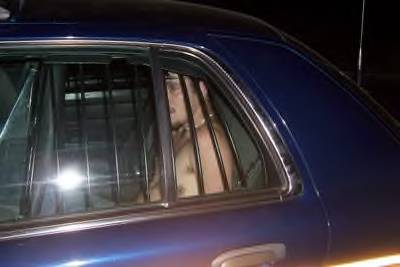
When one of the officers asked the mother to step back, the son thought we had insulted her, said we were not going to talk to his Momma that way and became violent. He was quickly restrained, put into the car and whisked away. The picture at the top was taken at that moment.
Given what I saw inside and outside the trailer (there was unbelievable squalor, dog feces throughout the residence) and how the family interacted with themselves and with us, there is a very good chance that the man we arrested had been the victim of a variety of abuses. That does not justify or explain away his actions. That does not ease the burden of the one he victimized, but it does soften the edge of our revulsion. How to offer compassion to such a man? I don’t know. Can there really be a divine spark in the soul of a sex offender? How can a man who has sex with children (and enjoys it immensely) even belong in the same creation? But does it really help anyone to treat them with rage and derision? I have to humble myself and believe that in everyone exists the potential for change. I hate the sins, but the Church asks us to love the sinner.
I say all this because there was a time in my life when many people thought I was headed for self-destruction, that I would follow in the footsteps of my father and succumb to the lure of an early death, that I would be a good for nothing drunk. In the Baptist church (of all places) I met I man who changed everything. He was not a cure-all. My life continued to spiral out of control for many, many years after I last saw him. But in him, for probably the first time in my life, I found unconditional acceptance. He saw the potential. He saw the God spark in me and he did not turn away. It was because of his influence that I even considered going to college. I was at the time a high school dropout with a GED working in a body shop painting cars. He helped me to believe that I was capable. He demonstrated Christian love. He was not afraid to love his neighbor as himself. Without him, you would not know me.
I learned that we must not see only the horrors of humanity, we must not be blind to the beauty of rebirth. Yes, we must protect ourselves, our families, our children. But our development as Christians and as humans stops if we become too battle-hardened. When we see only the spiked hair, or the filthy clothes, or the odd behavior, or the rundown home we are only seeing the effect, not the cause.
What can we do? Christ said to feed the hungry and clothe the naked. That’s a good place to start.
October 16, 2006
Strength and Honor
 “It is not the critic who counts; not the man who points out how the strong man stumbles, or where the doer of deeds could have done them better. The credit belongs to the man who is actually in the arena, whose face is marred by dust and sweat and blood; who strives valiantly; who errs, who comes short again and again, because there is no effort without error and shortcoming; but who does actually strive to do the deeds; who knows great enthusiasms, the great devotions; who spends himself in a worthy cause; who at the best knows in the end the triumph of high achievement, and who at the worst, if he fails, at least fails while daring greatly, so that his place shall never be with those cold and timid souls who neither know victory nor defeat.”
Teddy Roosevelt
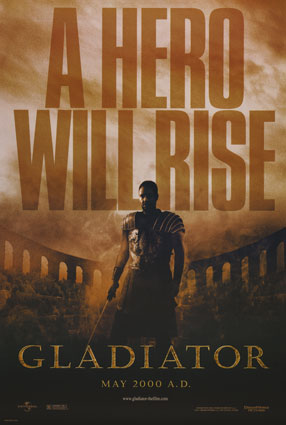
My younger brother Terry and I greet each other with the words, “Strength and Honor.” It’s a line lifted directly from the movie “Gladiator.” Not a great movie and perhaps greeting each other this way is a bit hokey, but what appears on the surface to be just light-hearted bravado hides a much deeper significance.
I am the third of five siblings. Terry, the fourth of five, and I have always enjoyed a particularly close relationship and have many interests in common. Nevertheless, we were, and to a large degree still are, polar opposites. Terry was always handsome, strong, brave, impetuous and headstrong, even violent. I was always homely, weak, scared, cautious and compliant. Truly yin and yang. Our strengths and weaknesses complimented each other. Ours is a relationship based on mutual respect and admiration.
We grew up in an alcoholic, abusive household with our other brother and two sisters. My mother had us one right after the other and by the time she was 22 she had five kids. In the days before disposable diapers, in a house with only cold running water, no bathtub, no bathroom facilities. It was a poor existence. We often felt winter’s bitter bite. My father did not try to save us. He did not come to the rescue. He was not true or strong or brave. In fact he did everything he could to abandon us and leave us at the mercy of our alcoholic mother. By the age of 36 he was dead. I’m not sure how much his disease killed him or how much it was him simply trying to escape the pain of existence.
One of the mechanisms I used to cope was to develop a fascination with warrior societies. The Spartans, the Samurai, the Vikings. I even went so far as to join the U.S. Marine Corps at the ripe old age of 17. I realize now that this fascination served at least two vital purposes, it helped me to address the very real fear I felt and it helped me to define what a man should be. Most of my life has been the search for strength and honor. Trying to find internal strength to face the fears and trying to find a way to be a man of honor.
In 1986 Terry gave me a lesson in humility, a lesson in how to be a man of strength and honor. In that year he fell and suffered a spinal cord injury in a construction accident. Terry survived the horrors of rehab and now spends his days in a wheelchair. Only those who have lived with someone recovering from such an injury can understand the magnitude of the physical and emotional struggle involved.
Terry never finished high school. To be more accurate, he never finished junior high school. He was kicked out for being too violent. Later in life, after his accident, Terry got his GED. Then he went to college (we started the same semester when I was 27 and he was 26) and eventually graduated with a B.A. in English from James Madison University. Years later he worked for a while as a teacher at the Virginia School for the Deaf and Blind teaching deaf students (using sign language). He is now learning to play the bass guitar.
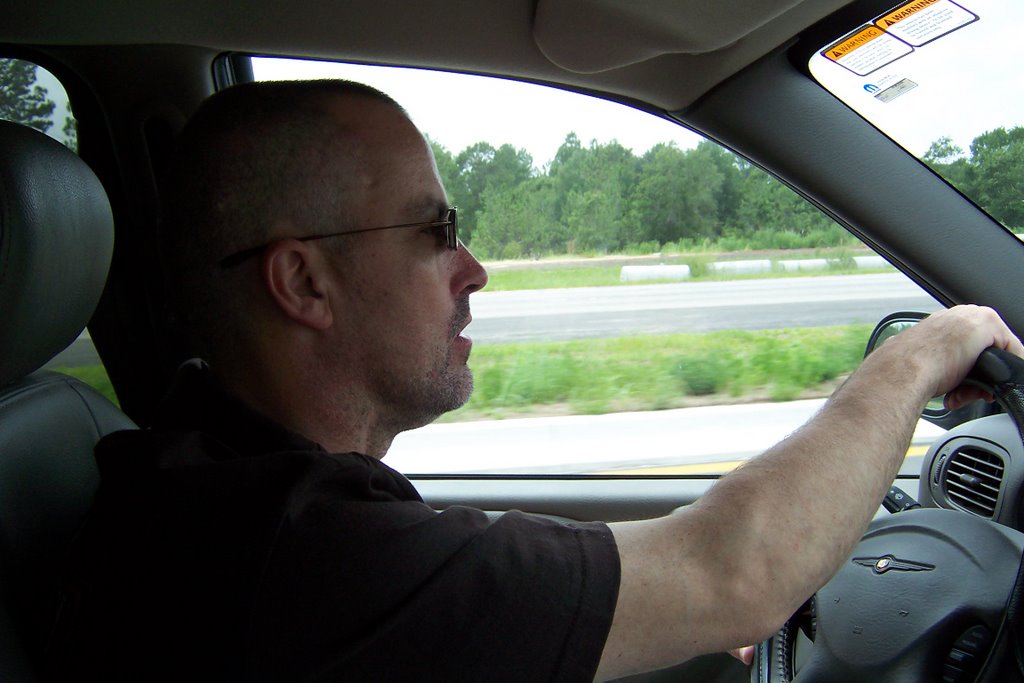
Terry is not handicapped in any real sense. He is completely self-reliant. He simply cannot walk. Terry has done more than most people without any physical impediment. He is a warrior and the bravest man I know. He has survived many trials. Not just survived, thrived. The fire of adversity has refined his spirit, purified his commitment to do whatever he sets his mind to do. One of the foundations of the Japanese martial art of Aikido is blending with the attack. If the attacker pulls, you push, if he pushes, you give way. By blending with the attack, you defeat it. Much the same in life, much the same with Terry. He took what came, blended with it and emerged complete.
I know Terry reads this blog. To him I say, strength and honor, brother.
October 12, 2006
Past Into Present

"In reality, the past is preserved by itself automatically. In its entirety, probably, it follows us at every instant; all that we have felt, thought and willed from our earliest infancy is there, leaning over the present which is about to join it, pressing against the portals of consciousness that would fain leave it outside."
Henri Bergson
(from Creative Evolution)
If you don’t think that past is present, ask any native Southerner. Even better, ask an Orthodox Christian. Both are immersed in a culture saturated with reminders of heroes, villains and stories from a past sometimes made fuzzy by time and circumstance. A somewhat skewed analogy to be sure, but for both a basic premise holds; tradition is good, hidebound tradition is worse.
To that point, there is a lot of debate/discussion in the Orthodox-blogosphere lately about newcomers to the Orthodox faith, and a somewhat surprising conversation about the meaning/purpose of priestly garb and accoutrements.
I think at the heart of these discussions is the question of how will Orthodoxy incorporate the past into the present? How to make compatible the Orthodox emphasis on slow change within traditional boundaries with the influx of new things, new ideas, and new people? This is certainly not the first time the church has been forced to have this discussion. Perhaps it is different here because America is such a unique place. Perhaps it is our hubris that makes us think so.
I have not experienced any of the “us against them” mentality or any ethnic bias. The majority of the parishioners are, like myself, converts who came looking for a place that was stable, a tradition that held to tradition, not a tradition of shifting standards and flexible truth. We are glad to be on the ark of salvation and we are not really concerned with what the priest does or does not wear, or whether or not it is what they would have worn in the old country, or the minutiae of what the buttons may or may not mean. We know we have found the true faith and (hopefully) we spend our time growing as much as we can. We don’t want change for change’s sake. We want what only the Church has to offer. We want to immerse ourselves in the reminders of the past, the Divine Liturgy, icons, incense, prayer, confession, fasting. We do not want to reinvent the Protestant tradition within the Orthodox Church. We spent too much time getting away to look back.
It is much the same here in the South. Anyone who has spent any time here has seen the ubiquitous Confederate battle flags, the innumerable other references to the Lost Cause. William Faulkner, and most other Southern writers, have as an enduring motif the notion that the past is still with us, inextricably bound up, and with, the present and has a palpable influence on everyday life and decisions. For Faulkner it is the lost antebellum splendor, the ghost of slavery, the pain of defeat. The past is of course not all good, the specter of Jim Crow, poverty, the good ol’ boy system, the Dukes of Hazzard. But there are so many good things to embrace: fish grits, manners, an acceptance of strangers, a certain piety, collective memory, family. The best we can do is to be willing to let go of that which harms us individually and as a people. We can hold on to that which is good, that which is right, to the ties that bind. We recognize and reject those who would hold on to any notion of inequality, separation or bigotry. Sometimes the past is best left there.
It’s the same way in relationships. The past can be a source of great comfort or great discomfort. It is a great place to look for lessons about dealing with the future. Sometimes the past seems so real that we feel trapped in it. Sometimes the past can be very comfortable, too comfortable. Inevitably we all have to (or at least should) face the reality that change in inevitable. People change. Relationships change. Everything changes. We are all in the process of becoming. It is much better if we are becoming what God would have us to be. Corporately and individually we must learn from our mistakes, forgive each other, be compassionate.
On a lighter note, here is my best try at a faux-Faulkner sentence. It’s a transitional passage from a much longer work:
“The man who put Yoknapatawpha on the Mississippi map showed him how to stand on the threshold of today, using new forms and experimenting, while casting an eye always backward for the sources, eeking out the effluvium of a past long, long dead, ghosting with ghosts that would not leave, shackled to the story of a war lost and an honor kept, embittered beyond recompense, seeking the antebellum splendor of a civilization that thought itself noble, but really now, even though the past was equal to present for those raised in ancestral families and on land long reaped by dissembling captives, was only a people still on the edge and still in the dark.”
Henri Bergson
(from Creative Evolution)
If you don’t think that past is present, ask any native Southerner. Even better, ask an Orthodox Christian. Both are immersed in a culture saturated with reminders of heroes, villains and stories from a past sometimes made fuzzy by time and circumstance. A somewhat skewed analogy to be sure, but for both a basic premise holds; tradition is good, hidebound tradition is worse.
To that point, there is a lot of debate/discussion in the Orthodox-blogosphere lately about newcomers to the Orthodox faith, and a somewhat surprising conversation about the meaning/purpose of priestly garb and accoutrements.
I think at the heart of these discussions is the question of how will Orthodoxy incorporate the past into the present? How to make compatible the Orthodox emphasis on slow change within traditional boundaries with the influx of new things, new ideas, and new people? This is certainly not the first time the church has been forced to have this discussion. Perhaps it is different here because America is such a unique place. Perhaps it is our hubris that makes us think so.
I have not experienced any of the “us against them” mentality or any ethnic bias. The majority of the parishioners are, like myself, converts who came looking for a place that was stable, a tradition that held to tradition, not a tradition of shifting standards and flexible truth. We are glad to be on the ark of salvation and we are not really concerned with what the priest does or does not wear, or whether or not it is what they would have worn in the old country, or the minutiae of what the buttons may or may not mean. We know we have found the true faith and (hopefully) we spend our time growing as much as we can. We don’t want change for change’s sake. We want what only the Church has to offer. We want to immerse ourselves in the reminders of the past, the Divine Liturgy, icons, incense, prayer, confession, fasting. We do not want to reinvent the Protestant tradition within the Orthodox Church. We spent too much time getting away to look back.
It is much the same here in the South. Anyone who has spent any time here has seen the ubiquitous Confederate battle flags, the innumerable other references to the Lost Cause. William Faulkner, and most other Southern writers, have as an enduring motif the notion that the past is still with us, inextricably bound up, and with, the present and has a palpable influence on everyday life and decisions. For Faulkner it is the lost antebellum splendor, the ghost of slavery, the pain of defeat. The past is of course not all good, the specter of Jim Crow, poverty, the good ol’ boy system, the Dukes of Hazzard. But there are so many good things to embrace: fish grits, manners, an acceptance of strangers, a certain piety, collective memory, family. The best we can do is to be willing to let go of that which harms us individually and as a people. We can hold on to that which is good, that which is right, to the ties that bind. We recognize and reject those who would hold on to any notion of inequality, separation or bigotry. Sometimes the past is best left there.
It’s the same way in relationships. The past can be a source of great comfort or great discomfort. It is a great place to look for lessons about dealing with the future. Sometimes the past seems so real that we feel trapped in it. Sometimes the past can be very comfortable, too comfortable. Inevitably we all have to (or at least should) face the reality that change in inevitable. People change. Relationships change. Everything changes. We are all in the process of becoming. It is much better if we are becoming what God would have us to be. Corporately and individually we must learn from our mistakes, forgive each other, be compassionate.
On a lighter note, here is my best try at a faux-Faulkner sentence. It’s a transitional passage from a much longer work:
“The man who put Yoknapatawpha on the Mississippi map showed him how to stand on the threshold of today, using new forms and experimenting, while casting an eye always backward for the sources, eeking out the effluvium of a past long, long dead, ghosting with ghosts that would not leave, shackled to the story of a war lost and an honor kept, embittered beyond recompense, seeking the antebellum splendor of a civilization that thought itself noble, but really now, even though the past was equal to present for those raised in ancestral families and on land long reaped by dissembling captives, was only a people still on the edge and still in the dark.”
October 9, 2006
Money, It's A Hit

I was watching television with my wife the other night and we happened upon one of the more prominent Christian channels, the Totally Bogus Network, and they were in the midst of one of their (never ending) fund drives. I can generally stand this insanity pretty well and occasionally even get a pretty good chuckle. Just remember the cardinal rule, whenever He is referred to as the Holy Ghost, something is about to bust loose. But this was beyond the ordinary. This was naked greed of a higher order. I wondered if this was even the same religion? Could this be Christianity? Did not Christ chase the moneychangers from the temple?
This is the verse they were milking:
Psalm 66:12 Thou hast caused men to ride over our heads; we went through fire and through water: but thou broughtest us out into a wealthy place.
Of course the refrain was over and over, “into a wealthy place” like a mantra. Nothing about feeding the poor or clothing the naked, nothing about He must increase and we must decrease, nothing about fasting, nothing holy. It was worship all right, but it was not God worship. It was all about seed faith, about sending every last dime to them because God has promised that He will return the favor. They believe that God is bound to the contract, that if you give money, He has to give it back with interest. I read somewhere that if this were really true, and if they truly believed it, they would be giving their money away as fast as they could!
To my mind, this is one of the inherent problems with sola scriptura. They (and it was a conspiracy) were using scripture out of context to further their own greedy agendas. Any bunch of self-ordained folk, with a so-called ministry can interpret the Bible as they see fit or to benefit their own bottom line. And more importantly, they are very good at getting others to buy into their corrupt message. Without tradition and church teaching, and in the wrong hands, scripture can become a very dangerous weapon.
At the same time, I am amazed and humbled by the faith of someone who can step so far out onto the limb and actually send their money. Even if they are following false prophets, some of them are clearly stepping out on faith. May we all be willing to do likewise.
This is the verse they were milking:
Psalm 66:12 Thou hast caused men to ride over our heads; we went through fire and through water: but thou broughtest us out into a wealthy place.
Of course the refrain was over and over, “into a wealthy place” like a mantra. Nothing about feeding the poor or clothing the naked, nothing about He must increase and we must decrease, nothing about fasting, nothing holy. It was worship all right, but it was not God worship. It was all about seed faith, about sending every last dime to them because God has promised that He will return the favor. They believe that God is bound to the contract, that if you give money, He has to give it back with interest. I read somewhere that if this were really true, and if they truly believed it, they would be giving their money away as fast as they could!
To my mind, this is one of the inherent problems with sola scriptura. They (and it was a conspiracy) were using scripture out of context to further their own greedy agendas. Any bunch of self-ordained folk, with a so-called ministry can interpret the Bible as they see fit or to benefit their own bottom line. And more importantly, they are very good at getting others to buy into their corrupt message. Without tradition and church teaching, and in the wrong hands, scripture can become a very dangerous weapon.
At the same time, I am amazed and humbled by the faith of someone who can step so far out onto the limb and actually send their money. Even if they are following false prophets, some of them are clearly stepping out on faith. May we all be willing to do likewise.
October 4, 2006
Living Reliquaries
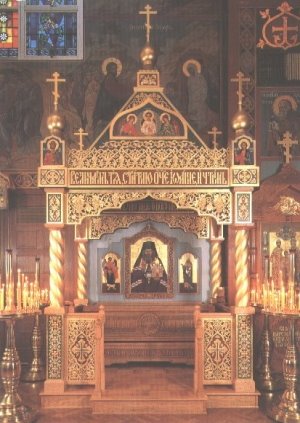 “According to the Orthodox belief the body remains a Temple of the Holy Spirit even after death. Redeemed, cleansed, sanctified by the blood of Jesus, consecrated by the indwelling Spirit, the bodies of Saints are drenched, as it were, to their very bones with divinity.”
Anthony M. Coniaris
Introducing The Orthodox Church: Its Faith and Life
My daughter, who is a freshman in college but living at home, was given the assignment in art class of making a reliquary. She did an outstanding job and crafted a reliquary for an imaginary child who died in the Holocaust. As many things in my life tend to do, it got me to thinking.
When I was first introduced to the tradition of Orthodox reliquaries, I’ll admit I was a bit put off. At first it seemed very strange (from my non-Orthodox background) to want to keep body parts or other items of the departed saints and martyrs. Without getting into a theological discussion, I understand that at least on one level they are tangible links to the past. Keeping relics is an act of love, a way of piercing the veil between this life and the life to come, a way or treasuring memory because Orthodox tradition, in a very tangible way, defines who we are and illuminates the path we are to follow. Now I more fully understand why in each altar there are relics of one of the martyrs.
Then I realized that one at least one level it was no different than wanting to hold on to an item left behind by a loved one, an article of clothing, even a photograph. I think the basic desire/instinct is the same. In a very real sense we are all living reliquaries. We all carry around relics of lost loved ones inside us as memories. Not as ornate as those crafted by the hand of man, but much more precious as we are all created in His likeness and image.
For me the most significant memory is that of my father. He died from the effects of acute alcoholism when he was just 36 years old. I have referred to his death obliquely in this blog before so I won’t belabor the point. In many ways his was the example of what not to do as a father. Still, I carry the memories because I do not want to lose him.
When I think of a reliquary this way it makes absolute sense. Not so much because it is a physical remnant of the actual person (that’s a whole different discussion), but because of how special that person was, of the impact they had in our lives or in the life of the Church.
Note: I realize that many of the posts on this blog conccern death in one fashion or another. This is a learning process for me as I would never have imagined the blog would have taken this turn. I will try to include less depressing material inthe future.
Subscribe to:
Posts (Atom)